
The Loyalty Trap
A framework for leaders asking for exclusivity without offering security, in an age when AI has already changed what security means

A week ago I wrote about an engineer who automated her own team so well that half of it was gone within six months. She survived that round. She also stopped raising her hand. Not out of bitterness. Because she had learned, precisely, what the organisation did with the value she created.
Here is the layer underneath that story I have not written about yet.
While AI is quietly reshaping who stays employed, a great many of those same employees are bound by contracts telling them they may not build anything else for themselves while they work there. No consulting, no advising, no paid work in their own time, even in fields with no overlap with their employer. Once, that restriction was a fair trade for real security. The company protected you, so you gave it your full loyalty in return.
That exchange is no longer remotely equal, precisely because of what AI has done to the security side of the equation. Adoption has made employment less certain than at any point in recent memory. The exclusivity clauses did not loosen to match. If anything, they tightened, as companies grew more protective of proprietary knowledge in a world where AI made it easier than ever to reconstruct or replicate what a departing employee understood. The obligation stayed. The protection went the other way.
I want to tell you about someone I have advised, through a composite, because the situation is too common to belong to just one person.
He was a senior engineer at a mid-sized technology firm, five years in, well regarded, well paid, and increasingly aware that his own AI fluency was exactly what made him replaceable on paper and irreplaceable in practice, depending on which quarter the company was having. His contract had a standard clause. He could not consult, advise, or take on any paid work outside the company, even in his own time and in a field with zero overlap with what his employer did. The company called it protecting its interests, which in an AI-enabled competitive landscape had come to mean almost anything.
Eighteen months ago, the layoffs started. Not because of anything he did. A restructuring, an AI-driven efficiency programme, the usual language. He was not among the first round. But he watched three colleagues he trusted leave within a single quarter, each one blindsided, each one walking out with a severance package that lasted a few months and a non-compete that outlasted it by a year, at the exact moment AI adoption across the industry meant fewer companies were hiring for the roles they used to fill.
He did the maths. If he was next, he would have a contractual obligation not to earn income in his own field for twelve months, in a market where AI had already shrunk the number of roles available to absorb him. The company that would enforce that clause had just demonstrated, three times over, that it owed him nothing beyond a notice period, in an environment it had itself made more precarious.
So he made a decision most people in his position quietly make. He kept doing his job well. And he stopped believing a word of the loyalty language in the town halls, especially the parts about how AI adoption was going to create more opportunity than it removed.
Here is the trap, stated plainly. Organisations increasingly ask for exclusivity, sometimes explicitly through non-compete clauses, sometimes implicitly through always-on cultures, while AI adoption simultaneously makes the underlying employment relationship less secure than it has been in decades. The obligation flows one direction. The protection does not flow back. And the very technology being deployed to increase efficiency is the same technology eroding the job security that used to make exclusivity feel like a fair trade.
This was never sustainable when both sides at least believed the old bargain still held, stay loyal, and the company would try to protect you when things got hard. AI adoption has made that belief nearly impossible to hold onto. What remains is the contractual language demanding loyalty, in a security environment the same technology helped dismantle.
Employees have noticed. They have not stopped complying. They have stopped believing, and those are very different things. Compliance without belief looks identical to engagement on a dashboard and is nothing like it in practice.
A framework for closing the gap, built for an AI-era workforce
I do not think exclusivity clauses are inherently wrong. Some genuinely protect real commercial interests, and AI has made intellectual property genuinely more portable and more valuable to protect. But if an organisation wants to ask for loyalty while deploying the very technology that makes employment less secure, it needs to offer something that makes the asking legitimate. Here is the approach I now put in front of leadership teams grappling with this.
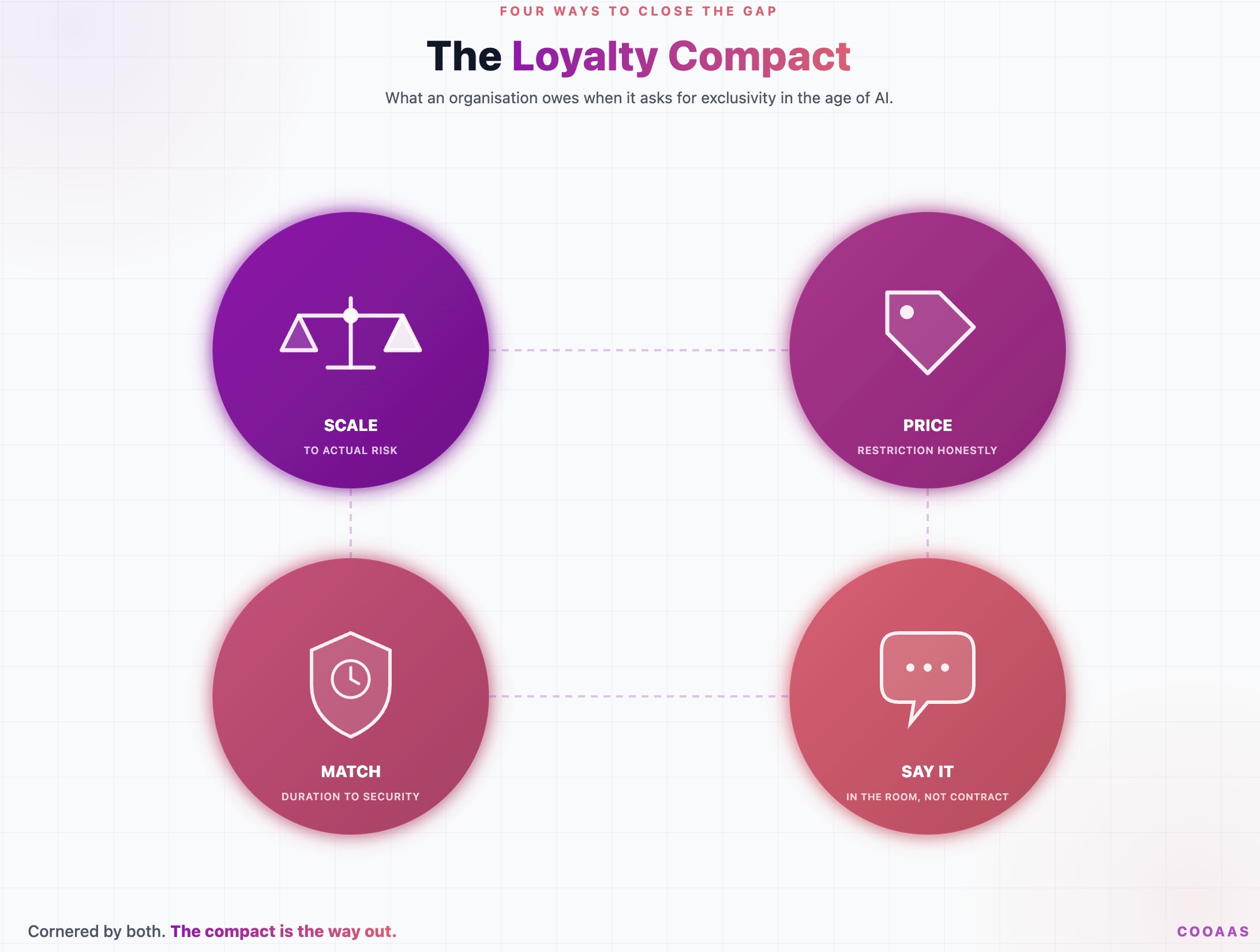
Match the obligation to the actual AI-driven risk, not the maximum legal reach. Most non-competes are written by lawyers optimising for the broadest possible protection, not for what the business genuinely needs in an AI context. A senior engineer building proprietary AI systems and a marketing coordinator using off-the-shelf AI tools do not carry the same competitive risk, yet they are often bound by identical clauses. Scope the obligation to what AI fluency actually exposes the business to. Anything broader is asking for loyalty you have not earned.
If AI adoption increases your organisation’s need for exclusivity, price that increase honestly. A restrictive clause has real economic cost to the person carrying it, and that cost has grown as AI has made specialised knowledge more valuable and more portable. If your organisation genuinely needs tighter protection because of what AI has changed, pay for it directly, through compensation that acknowledges the constraint, or through a defined severance commitment that activates specifically when AI-driven restructuring is the reason someone is let go.
Tie the restriction’s duration to the security you are actually providing in an AI-disrupted market. A twelve month non-compete paired with a two week notice period was never balanced. It is even less balanced when AI adoption has shrunk the pool of roles available to someone bound by that restriction. If the organisation cannot commit to security anywhere close to matching the restriction, the restriction should shrink to match what can honestly be offered.
Say the quiet part in the room, specifically about AI, not just in the contract. Most organisations avoid ever discussing this openly, hoping nobody connects their AI transformation programme to the erosion of the security their contracts still assume. Leaders who address it directly, acknowledging that AI has changed the deal and being honest about what the organisation can and cannot promise in return, earn more real loyalty than any clause could enforce. People do not expect certainty anymore. They expect honesty about exactly what AI has changed.
He never got that honesty from his employer. So he did what most people in his position now quietly do. He complied with the letter of his contract and gave nothing beyond it. Not out of malice. Out of rational self-protection, learned the hard way, from watching what AI-driven restructuring did to the people who trusted the company before him.
The organisations that retain real loyalty through this next decade of AI adoption will not be the ones with the broadest contracts. They will be the ones honest enough to ask only for what they are willing to earn, in a world their own technology has already changed.